
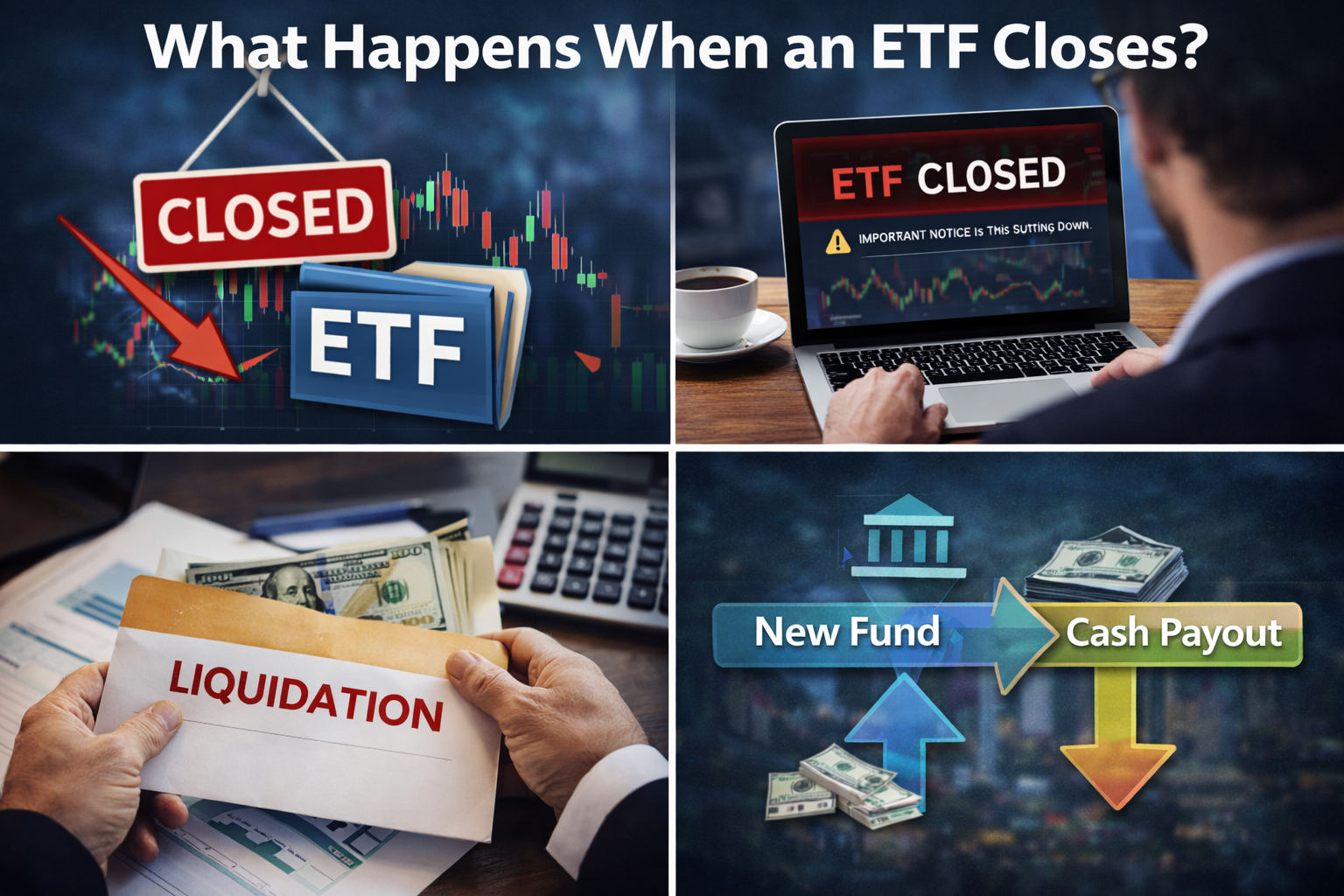
The first time I read the phrase “fund liquidation” in a press release, I honestly thought something had gone very wrong. It sounded dramatic, almost catastrophic. In reality, ETF closures are usually structured, orderly, and far less exciting than they sound. They are rarely scandals. Most of the time, they are simply business decisions.
ETFs close more often than investors expect. The ETF industry is extremely competitive. If a fund doesn’t attract enough assets, doesn’t trade enough volume, or simply isn’t profitable for the sponsor, it may be shut down. That decision is usually economic, not emotional. The company behind the ETF decides the numbers no longer justify the ongoing costs.
According to the SEC’s Investor Bulletin on fund liquidations, when a fund liquidates, it sells its assets and distributes the remaining cash to shareholders. It is not bankruptcy. It is a controlled wind-down process.
Source: https://www.investor.gov/introduction-investing/general-resources/news-alerts/alerts-bulletins/investor-bulletins-96
Closing does not always mean the same thing
When investors hear that an ETF is “closing,” they may be referring to different situations. Sometimes it is a liquidation. Sometimes it is a merger into another ETF. In a merger, your shares convert into shares of a different fund. In a liquidation, you eventually receive cash.
This article focuses on liquidation, because that is the scenario that tends to create confusion.
What actually happens step by step
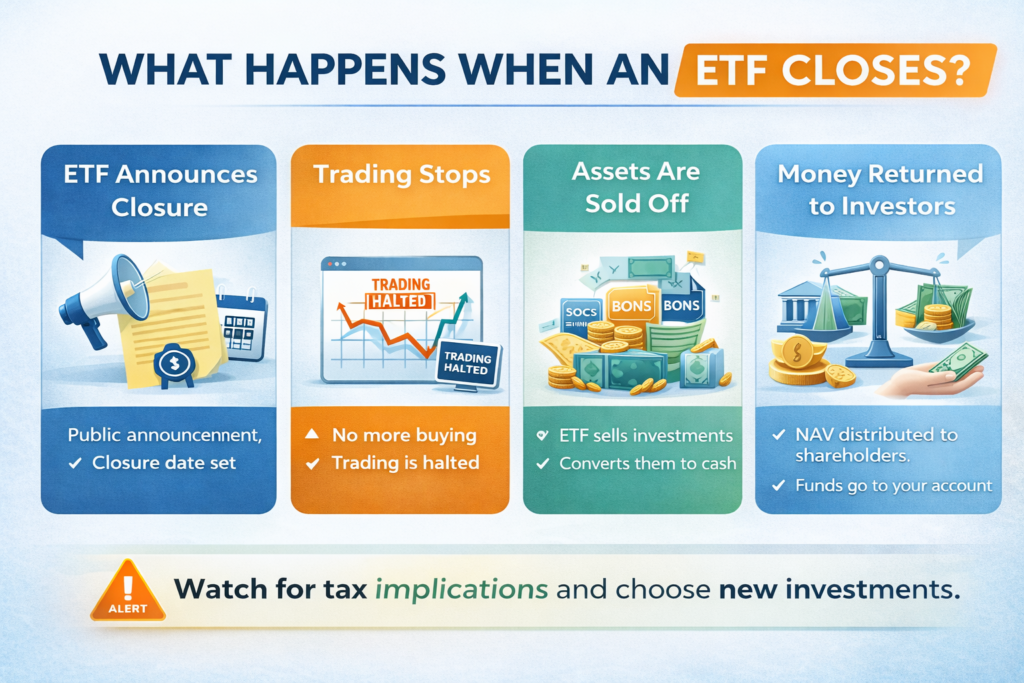
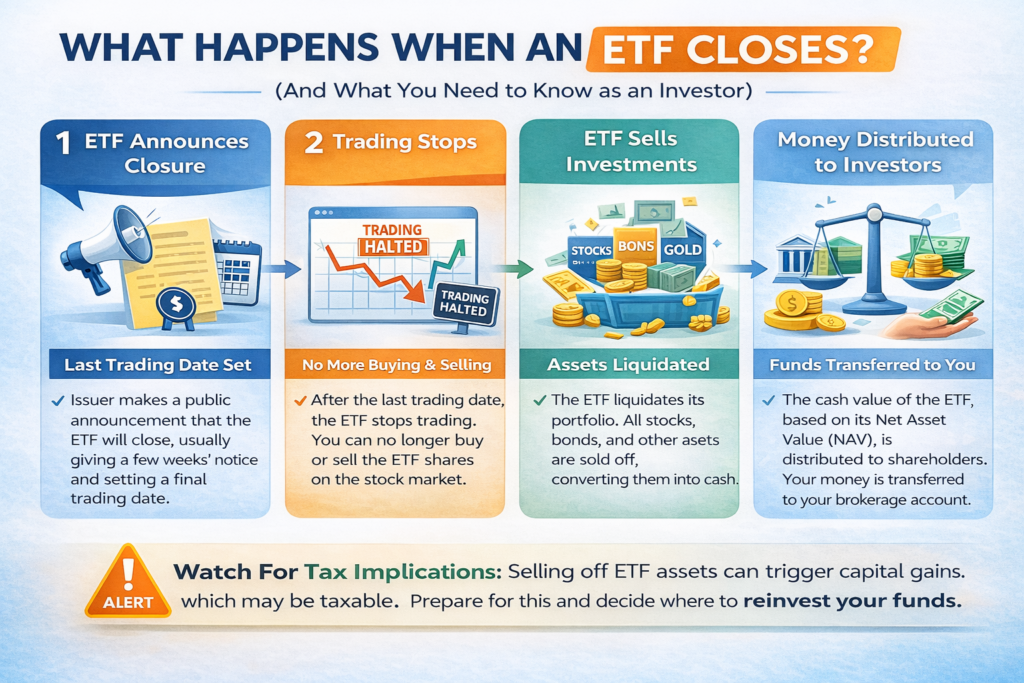
When an ETF sponsor decides to liquidate a fund, the first thing you’ll see is a public announcement. This announcement includes two critical dates: the last trading day and the liquidation date.
A recent real-world example: Fidelity announced in October 2025 that several ETFs would be liquidated, with a defined last trading date and liquidation timeline.
Source: https://newsroom.fidelity.com/pressreleases/fidelity-investments-announces-liquidation-of-five-exchange-traded-funds/s/6ed59999-7cdb-43c0-9b65-6144b397a0ea
The timeline generally unfolds in four phases.
First, the announcement. The issuer publishes the dates and explains when trading will stop. Sometimes the creation of new ETF shares is halted before trading ends.
Second, the final trading period. Until the last trading day, you can sell your ETF shares on the exchange just like any other stock. However, liquidity may decline as the closure approaches. Bid-ask spreads can widen, especially in small or niche funds. That matters, because wider spreads can mean less favorable execution prices.
Third, delisting. After the final trading day, the ETF stops trading on the exchange. If you still hold shares, you cannot sell them in the open market anymore. You simply wait for the liquidation process to complete.
Fourth, distribution. The fund sells its underlying holdings, settles expenses, and distributes the remaining cash to shareholders. In many cases, investors receive the cash within a few business days after delisting, although timing can vary. Charles Schwab explains that liquidation proceeds are typically paid shortly after trading stops.
Source: https://www.schwab.com/learn/story/what-happens-if-your-etf-closes
ETF Closure – Quick Facts
| Item | Typical Figure |
|---|---|
| Average AUM of closed ETFs | ~$50M |
| Average lifespan before closing | ~5 years |
| Notice period before last trading day | 2–4 weeks |
| Cash payout after delisting | 3–5 business days |
| Tax impact (taxable account) | Treated like a sale |
¿Debo vender antes de la liquidación o esperar?
This is where the situation becomes practical rather than theoretical.
If you sell before the last trading day, you control the timing. That can be useful for tax planning. You also avoid potential liquidity deterioration near the final date. On the other hand, if spreads are already wide, your execution price may not be ideal.
If you hold through liquidation, you do not need to trade at all. The fund will convert your position into cash at its net asset value after expenses. That sounds simple, and often it is. But you give up control over timing, and you may trigger a taxable event anyway.
Personally, I prefer controlling the sale unless the position is very small. I do not like being forced into cash on someone else’s schedule.
The tax angle most investors overlook
This is the part that actually matters.
When an ETF liquidates in a taxable brokerage account, the payout is generally treated as if you sold your shares. That means you may realize a capital gain or a capital loss depending on your cost basis and holding period. Schwab highlights that liquidation distributions can have tax consequences similar to a sale.
Source: https://www.schwab.com/learn/story/what-happens-if-your-etf-closes
There is another layer. As the ETF sells its underlying holdings during the wind-down, it may distribute capital gains. Even if you did not actively sell, you could receive a taxable distribution.
In tax-advantaged accounts like IRAs, the immediate tax impact may not apply. However, you still face the inconvenience of being moved into cash and having to reinvest.
Why do ETFs close in the first place?
Most ETF closures are driven by economics. Funds with low assets under management and low trading volume struggle to remain profitable. Sponsors have operational costs, regulatory costs, and management costs. If assets do not grow, closure becomes a rational decision.
Investopedia noted that ETFs that closed in 2023 had an average of roughly 54 million dollars in assets under management and an average lifespan of about 5.4 years. That figure shows that even funds that survive several years are not guaranteed permanence.
Source: https://www.investopedia.com/articles/exchangetradedfunds/09/etf-out-of-business.asp
Industry data from ETFGI regularly shows both hundreds of new launches and hundreds of closures in active years. Product turnover is normal in this industry.
Source: https://etfgi.com/news/press-releases/2025/07/etfgi-reports-global-etfs-industry-had-record-1308-new-products
An ETF closing does not mean ETFs as a structure are failing. It usually means that particular product did not attract enough demand.
What happens to the price near closure?
Under normal conditions, ETFs trade very close to their net asset value thanks to the creation and redemption mechanism. As closure approaches, however, trading activity can decline. Market makers may become less active. Spreads may widen.
This does not automatically mean the ETF will trade at a massive discount. But it does mean investors should use limit orders rather than market orders, especially in the final days of trading.
My personal process when an ETF announces liquidation
When I receive a notification that one of my ETFs is closing, I go through a short mental checklist.
First, I look at whether the position is in a taxable account. If it is, I evaluate my unrealized gain or loss and consider whether selling immediately makes more sense than waiting.
Second, I examine liquidity. If volume is still reasonable and spreads are tight, I am more comfortable selling proactively.
Third, I identify a replacement if I want to maintain the same exposure. If the closing ETF tracked small-cap value stocks or short-term Treasuries, I research a larger, more established alternative before exiting.
Fourth, I consider whether the ETF holds complex
Our mission is simple: make ETF investing clear, practical, and long-term focused. Discover our full story on the About page.
Leave a Reply