
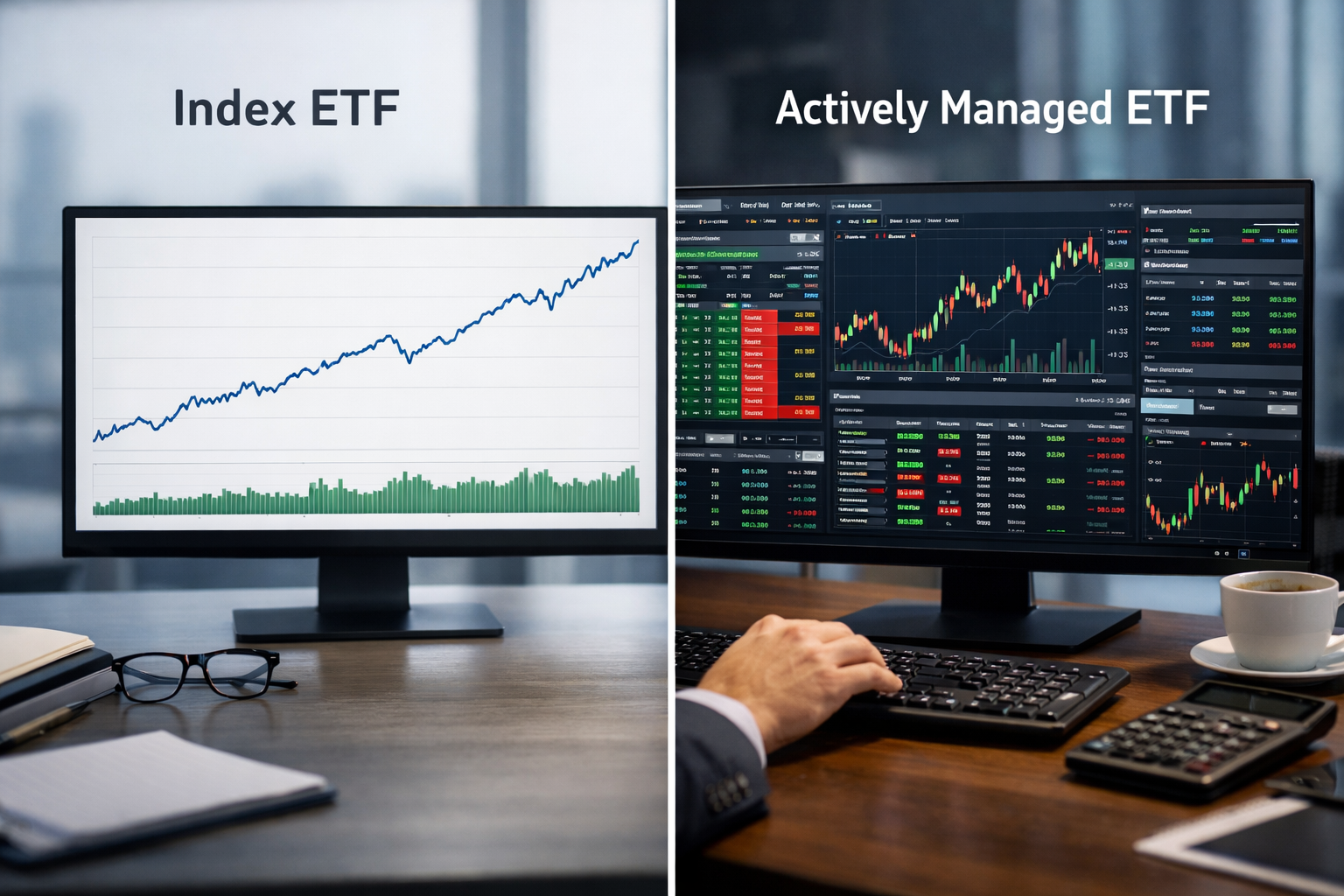
If you’ve ever compared two ETFs that look almost identical and wondered why one charges three times more than the other, you’re not alone. I’ve done that more times than I’d like to admit. At first glance they both hold stocks, both trade on exchanges, and both promise diversification. So what exactly are you paying for?
Here’s the honest answer: for most investors, an index ETF is usually the better default choice. That doesn’t mean actively managed ETFs are useless. It just means the bar they have to clear is higher than most people realize.
Let’s walk through it calmly, with real numbers and without pretending investing is a philosophical debate.
What an Index ETF actually does
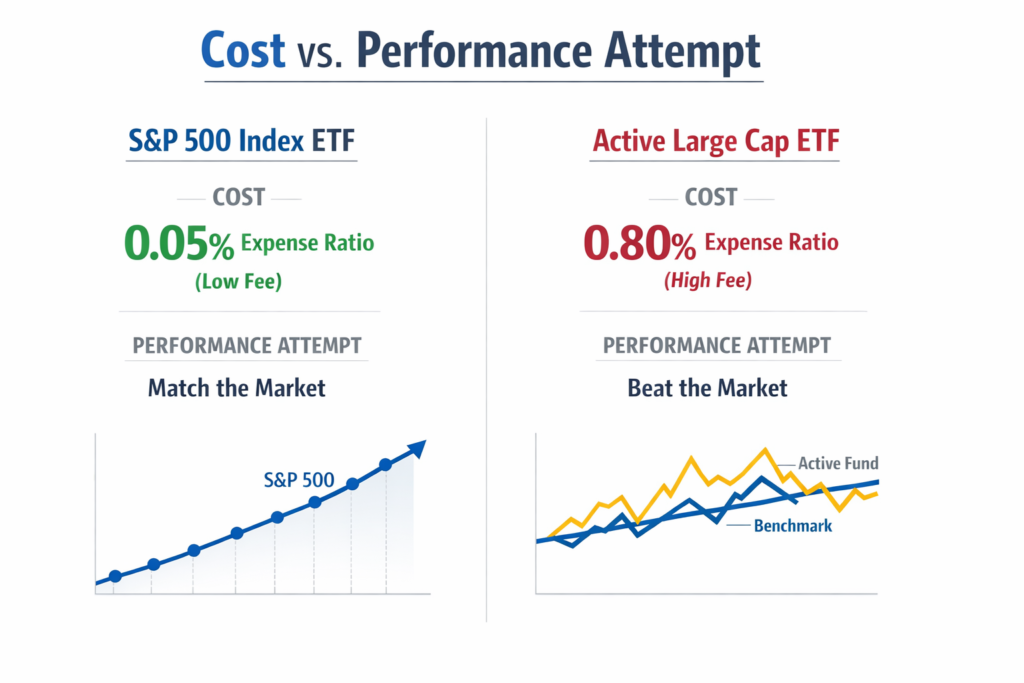
An index ETF simply tries to replicate a benchmark. If it tracks the S&P 500, it owns the same companies in roughly the same proportions. If it tracks the total U.S. market, it spreads exposure across thousands of companies.
The manager is not trying to outsmart the market. The goal is accuracy and efficiency.
That simplicity is powerful. Costs stay low because there’s no big research team making constant decisions. According to the Investment Company Institute, the average expense ratio for index equity ETFs in 2024 was around 0.14%, and index bond ETFs averaged about 0.10%. That’s roughly $14 per year for every $10,000 invested in a stock index ETF.
Esa diferencia de costo puede parecer pequeña. No lo es.
What you’re really paying for in an Active ETF
An actively managed ETF has a team making decisions. They choose which securities to overweight or underweight, when to shift allocations, and sometimes they use tactical strategies that deviate significantly from the benchmark.
In theory, that flexibility allows them to outperform. In practice, they have to overcome higher costs, trading expenses, and intense market competition.
SEC research has highlighted a gap in average expense ratios. Asset-weighted figures cited in SEC analysis show active ETFs around 0.49% versus roughly 0.12% for passive ETFs. That spread matters.
If you’re paying an extra 0.35% per year, the manager needs to outperform by more than that just to break even after fees.
Y eso es antes de que entren en escena los impuestos y las fricciones comerciales.
Quick Comparison: Index ETF vs Actively Managed ETF:
| Feature | Index ETF | Actively Managed ETF |
|---|---|---|
| Objective | Track a market index | Try to outperform the market |
| Management Style | Passive | Active (portfolio manager makes decisions) |
| Expense Ratio | Very low (0.03% – 0.10%) | Higher (0.50% – 1%+) |
| Portfolio Turnover | Low | Higher |
| Transparency | Very high (you know what it tracks) | Depends on strategy |
| Long-Term Odds of Beating the Market | Not designed to | Statistically low after fees |
| Best For | Long-term, cost-focused investors | Investors seeking alpha and accepting higher risk |
The performance problem most people ignore
Active management does beat the market sometimes. That part is true. The uncomfortable part is consistency.
S&P Dow Jones publishes the SPIVA Scorecard, which tracks how often active managers outperform their benchmark. The year-end 2024 SPIVA report shows that over longer time horizons, a large majority of active managers underperform their index benchmarks. The longer the period, the more pronounced the underperformance becomes.
Morningstar’s research tells a similar story. In one recent analysis, only about 38% of active funds outperformed their passive counterparts over the measured period.
That doesn’t mean active investing never works. It means selecting the right manager in advance is statistically difficult.
And even if you pick a winner, staying a winner is another challenge.
The math that compounds quietly
Let’s keep it simple.
Imagine you invest $100,000.
With an index ETF charging 0.14%, you’re paying about $140 per year. With an active ETF charging 0.49%, you’re paying roughly $490 per year.
That’s a $350 annual difference.
On $500,000, that becomes $1,750 per year.
Fees compound just like returns do. Every dollar spent on expenses is a dollar that doesn’t stay invested generating future returns.
Active management has to add meaningful value consistently to justify that drag.
Taxes and turnover
One of the underappreciated advantages of many index ETFs is tax efficiency. Because they typically have low turnover, they often distribute fewer capital gains.
Active ETFs may trade more frequently. Higher turnover can increase transaction costs and, depending on structure and strategy, potentially impact tax efficiency.
No todos los ETF activos son ineficientes, pero es un factor que siempre examino antes de comprar.
When an Active ETF can make sense
There are situations where active management has a stronger case. Certain bond markets, credit strategies, or less efficient asset classes can provide room for skill to matter more. In those niches, a disciplined, clearly defined strategy may justify higher costs.
The key word is disciplined. If the strategy sounds vague, overly complex, or marketing-heavy, I pass.
Sometimes a core and satellite approach works well. You keep 70% to 90% of your portfolio in broad, low-cost index ETFs and allocate a smaller portion to specific active strategies where you have conviction.
That way, you’re not betting your financial future on one manager’s continued brilliance.
My bottom line
If I’m advising someone building a long-term portfolio in the U.S., I start with index ETFs. They are low cost, broadly diversified, and historically difficult for most active managers to beat after fees.
Active ETFs are tools, not magic. They can add value in certain contexts, but they require deeper analysis and realistic expectations.
If you want simplicity, transparency, and cost control, index ETFs win by default.
If you want targeted strategies and you understand the trade-offs, active ETFs can have a place.
Just don’t confuse higher fees with higher intelligence.
Fuentes:
S&P Dow Jones Indices — SPIVA U.S. Scorecard Year-End 2024
https://www.spglobal.com/spdji/en/documents/spiva/spiva-us-year-end-2024.pdf
Investment Company Institute — Trends in the Expenses and Fees of Funds, 2024
https://www.ici.org/files/2025/per31-01.pdf
U.S. Securities and Exchange Commission — Research on Active ETF Growth
https://www.sec.gov/files/dera-fast-growing-mrkt-2602.pdf
Morningstar Research Summary
https://finance.yahoo.com/news/morningstar-active-funds-underperformed-passive-190751122.html
-If you want to understand the philosophy behind this site and how we approach ETF investing, you can learn more on our About page
Leave a Reply