
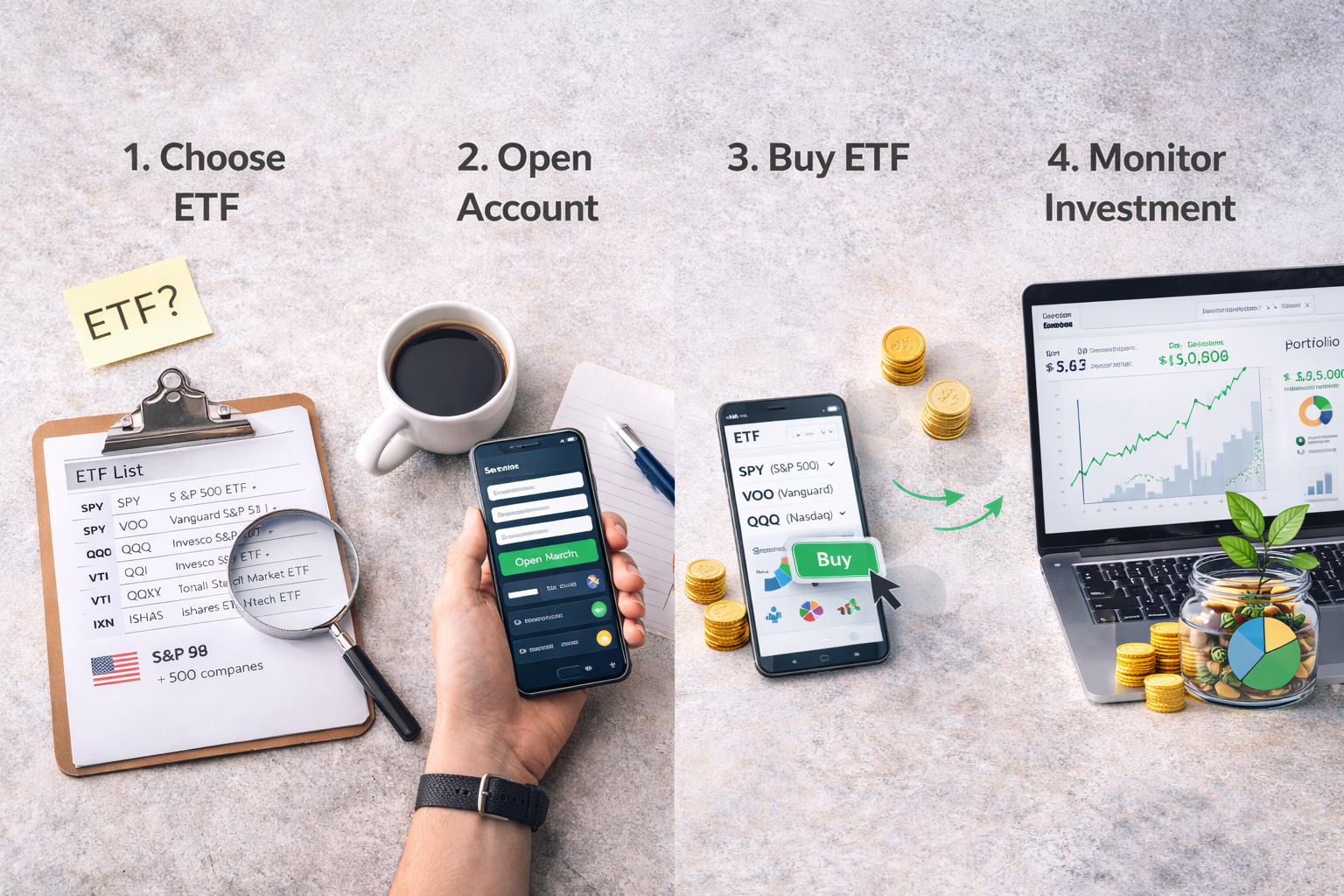
When I first decided to take investing seriously, I felt overwhelmed. Stocks, bonds, mutual funds, savings accounts… it all felt like a maze. Then someone introduced me to ETFs — and suddenly investing didn’t feel like a mystery anymore.
ETFs (Exchange-Traded Funds) are one of the simplest, most powerful tools for long-term investors. They combine diversification, low costs, and flexibility in a way that works even if you’re just getting started.
In this 2026 guide, I’ll walk you through exactly how to invest in ETFs step by step, using real numbers and real platforms you can trust.
Let’s start with the basics.
Step 1: Understand What an ETF Is
An ETF is like a basket of investments — typically stocks or bonds — that trades on the stock market just like a share of a company.
For example:
SPY sigue el índice S&P 500
VTI rastrea el mercado de valores total de EE. UU.
El BND posee bonos estadounidenses con grado de inversión
Here’s the official explanation from the SEC:
👉 https://www.sec.gov/investor/pubs/etfs
Instead of choosing individual stocks, you can buy one ETF and instantly own a little slice of many investments. That’s diversification.
Step 2: Know Why ETFs Are Useful
Before we start buying, let’s be honest about why ETFs are worth your time:
1. Low Cost
Most ETFs have very low expense ratios.
Example: Vanguard’s S&P 500 ETF (VOO) costs 0.03% annually.
👉 https://investor.vanguard.com/investment-products/etfs/profile/voo
That’s $3 a year for every $10,000 invested.
Compare that to many mutual funds charging 0.7–1% or more.
2. Diversification
ETFs spread risk. Instead of betting on one stock, you own hundreds or thousands.
VTI (Total U.S. Market ETF) holds over 3,500 stocks.
👉 https://investor.vanguard.com/investment-products/etfs/profile/vti
3. Flexibility
ETFs trade like stocks. You can buy or sell any time during market hours.
Step 3: Pick Your Broker
You need a brokerage account to buy ETFs. Here are a few widely used and credible platforms in the U.S.:
- Vanguard – great for long-term investors
➤ https://investor.vanguard.com - Fidelity – no commissions on many ETFs
➤ https://www.fidelity.com - Charles Schwab – lots of ETF choices
➤ https://www.schwab.com - Robinhood – beginner-friendly app
➤ https://robinhood.com
Fees and platform usability vary, but for beginners, low-cost brokers with no commission on ETF trades are ideal.
Step 4: Decide on Your Strategy
There are two big approaches:
A) Comprar y mantener
This is the simplest: buy ETFs and hold them for the long term.
B) Promedio del costo en dólares (DCA)
Invest a fixed amount (e.g., $200/month) regardless of market ups and downs.
The Vanguard DCA study shows that timing the market is tough — and regular investing usually wins out for long-term goals.
👉 https://corporate.vanguard.com/content/dam/corp/research/pdf/cost_averaging_invest_now_or_temporarily_hold_your_cash.pdf
Personally, I prefer DCA because it removes emotion from the equation.
Step 5: Choose ETFs That Fit Your Goals
Not all ETFs are the same. Here are some beginner-friendly examples:
| ETF Ticker | Type | What It Tracks | Expense Ratio |
|---|---|---|---|
| VOO | Stock | S&P 500 | 0.03% |
| VTI | Stock | Total U.S. Market | 0.03% |
| VXUS | International | Global ex-U.S. stocks | 0.07% |
| BND | Bonds | U.S. Bond Market | 0.03% |
This mix can give you broad market coverage.
If you’re young and investing for retirement, a heavier stock allocation makes sense. If you want income and stability, add bond ETFs.
Step 6: Use Real Numbers to Plan
Let’s do a realistic example.
Say you invest $300 per month in a broad stock ETF like VTI.
That’s $3,600 per year.
Assuming an average return of 7% annually (not guaranteed), your investment might grow approximately like this:
10 años → ~50.000 USD
20 años → ~157.000 USD
30 años → ~365.000 USD
This is just an estimate, not a prediction. But it shows how consistency compounds over time.
Historical S&P 500 averages are around 9–10% nominal return, but actual results vary year to year.
👉 https://pages.stern.nyu.edu/~adamodar/New_Home_Page/datafile/histretSP.html
Step 7: Make Your First ETF Trade
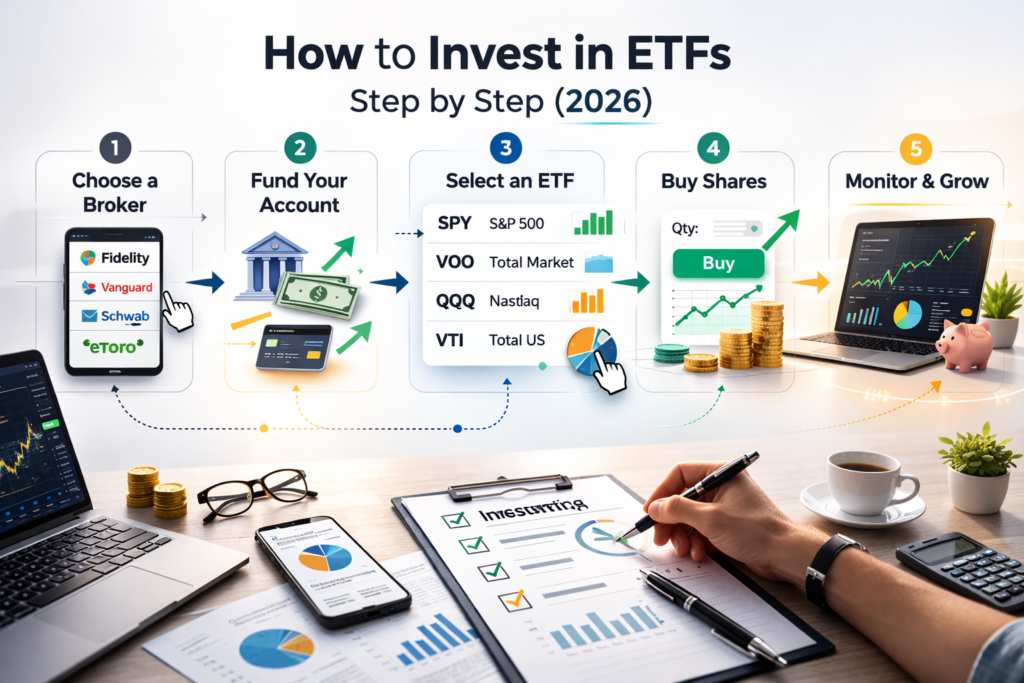
Here’s what typically happens:
- Log into your brokerage account
- Search by ETF ticker (e.g., VTI)
- Choose “Buy”
- Enter number of shares or dollar amount
- Confirm the order
If you’re using DCA, you can often set up an automated monthly purchase.
Step 8: Rebalance Over Time
Rebalancing means adjusting your portfolio so it stays aligned with your goals.
For example:
If you planned 80% stocks and 20% bonds, but after a strong stock market it’s now 90/10, you might rebalance to bring it back to 80/20.
Many brokers offer tools to help rebalance automatically.
⚠️ Step 9: Know the Risks
ETFs aren’t risk-free.
- If markets fall, your ETFs fall.
- Sector-specific ETFs can be volatile.
- Bond ETFs can lose value if interest rates rise.
ETFs reduce certain risks (like single stock risk), but they don’t eliminate market risk.
Always invest within your risk tolerance and time horizon.
Step 10: Keep Learning
Investing is a journey.
Once you’re comfortable with broad ETFs, you can explore:
ETF de dividendos
ETF del sector internacional
ETF temáticos (por ejemplo, energía limpia)
Just remember: complexity should only be added once you understand basics.
Final Thoughts
When I look back at my early investing days, the moment ETFs became part of my strategy was a turning point.
They gave me:
- Simplicity
- Low cost
- Diversification
- A scalable way to build wealth
If you’re getting started in 2026, ETFs are one of the strongest foundations you can build.
Start small, stay consistent, and let time do the heavy lifting.
¿Te interesa saber quién está detrás de ETF Anchor y por qué nos centramos en la inversión a largo plazo en ETF? Visita nuestra página “Acerca de”
Leave a Reply