
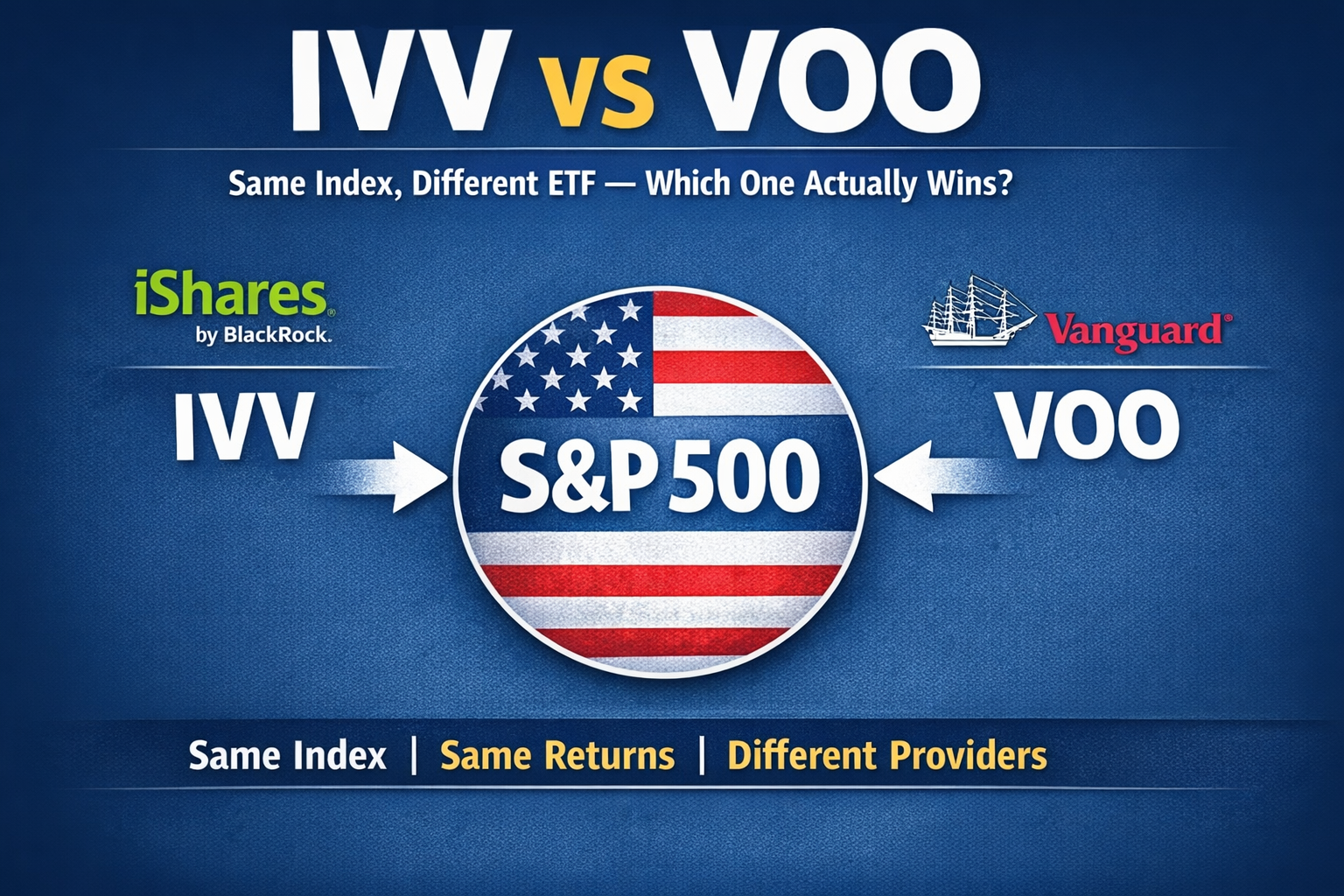
If you’ve spent any time researching ETFs, you’ve probably noticed something slightly ridiculous: there are multiple ETFs that track the exact same index.
The S&P 500, arguably the most famous stock market index in the world, is tracked by several funds. Among them, two of the biggest and most popular are IVV and VOO.
Both track the same benchmark. Both hold the same companies. Both are extremely cheap.
So naturally the question appears: if they are basically identical, does one actually win?
After digging into the details, I realized the answer is both simple and slightly more interesting than it looks.
What IVV and VOO Actually Are
Let’s start with the basics.
Both ETFs track the S&P 500 Index, which includes roughly 500 of the largest companies in the United States. That means when you buy either ETF, you are effectively buying a tiny piece of companies like Apple, Microsoft, Amazon, Nvidia, and JPMorgan.
The idea is simple: instead of trying to pick individual stocks, you buy the entire market.
Historically, this strategy has worked surprisingly well. Over long periods, the S&P 500 has delivered average annual returns of around 10% per year before inflation.
That’s why many investors treat an S&P 500 ETF as the “core” of their portfolio.
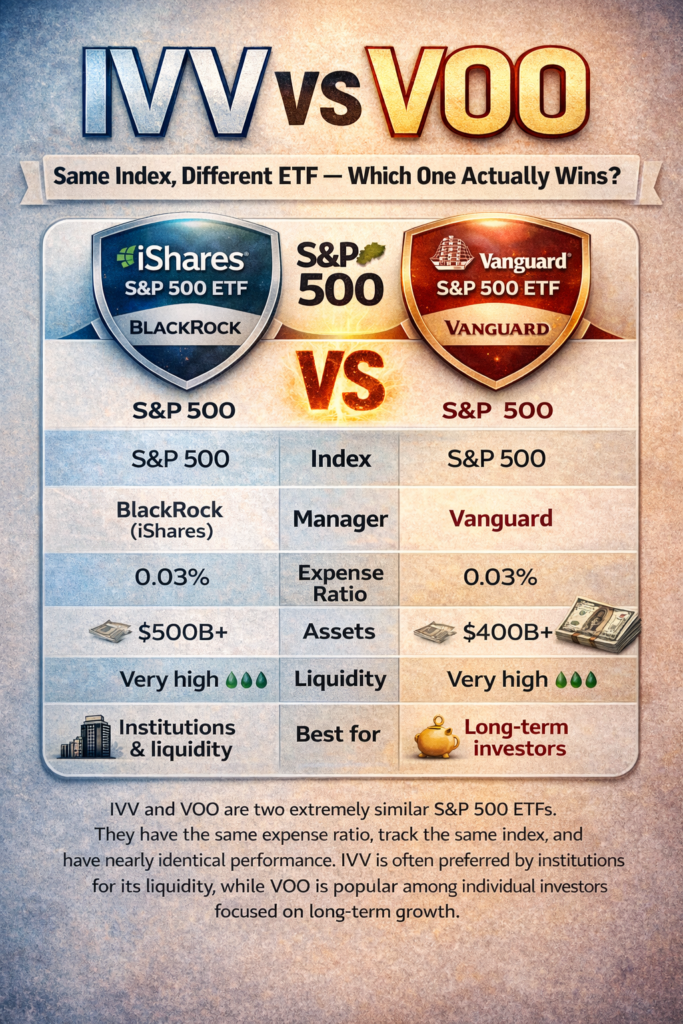
But while IVV and VOO follow the same index, they are run by different asset managers.
| ETF | Full Name | Provider | Inception |
|---|---|---|---|
| IVV | iShares Core S&P 500 ETF | BlackRock | 2000 |
| VOO | Vanguard S&P 500 ETF | Vanguard | 2010 |
Both companies are giants in the ETF world.
BlackRock is the largest asset manager on Earth. Vanguard is the company that practically invented low-cost index investing.
So whichever one you choose, you’re not exactly trusting amateurs.
Expense Ratio: A Tie (And That’s Good News)
If you invest for the long term, fees matter more than most people think.
Even a small annual fee can quietly eat thousands of dollars from your portfolio over decades.
Luckily, both IVV and VOO are extremely cheap.
| ETF | Expense Ratio |
|---|---|
| IVV | 0.03% |
| VOO | 0.03% |
That means you pay $3 per year for every $10,000 invested.
To put that into perspective, many actively managed funds still charge around 0.5% to 1% annually.
Over 30 years, that difference can become massive.
So in terms of cost, there is basically no winner here. Both ETFs are among the cheapest ways to invest in the S&P 500.
Holdings: Almost Identical
Since both funds track the same index, their portfolios look nearly identical.
The top holdings typically include:
| Top Holdings | Approx Weight |
|---|---|
| Apple | ~6–7% |
| Microsoft | ~6–7% |
| Nvidia | ~4–5% |
| Amazon | ~3–4% |
| Alphabet | ~3–4% |
Because both funds replicate the same index, their sector allocations and holdings are nearly the same.
This means your exposure to the U.S. economy will be almost identical.
Technology still dominates the index, financial companies come next, and healthcare usually sits not far behind.
In other words, switching from one ETF to the other won’t suddenly change your portfolio.
Assets Under Management: VOO Has the Edge
One difference that does exist is size.
VOO has attracted enormous investor demand in recent years.
Recent estimates show:
| ETF | Assets Under Management |
|---|---|
| VOO | ~$700+ billion |
| IVV | ~$700+ billion |
Both are enormous funds, but VOO often edges slightly ahead in total assets and inflows.
Why does that matter?
Large funds tend to have:
- better liquidity
- tighter bid-ask spreads
- lower trading friction
But at this scale, the difference is almost irrelevant.
Both funds trade billions of dollars per day.
Liquidity and Trading Volume
If you are a long-term investor, liquidity probably doesn’t matter much.
But traders care about it.
VOO generally sees slightly higher trading volume, though IVV is still extremely liquid.
In practical terms:
- Day traders may prefer SPY (even higher liquidity)
- Long-term investors won’t notice a difference between IVV and VOO
You could buy either one with a market order and barely see a difference in execution price.
Dividend Yield
Both ETFs distribute dividends from the companies in the S&P 500.
Typical dividend yields are around 1.3%–1.5%, depending on market conditions.
In many years, IVV and VOO have almost identical dividend yields.
Some comparisons show IVV occasionally slightly higher, but the difference is usually tiny.
For long-term investors, it’s basically a statistical rounding error.
Performance: Nearly Impossible to Separate
This is where things get funny.
Since both funds track the same index with the same cost, their performance is nearly identical.
Over long periods, the difference between IVV and VOO is often less than 0.05% per year.
Sometimes IVV slightly wins.
Sometimes VOO slightly wins.
Most of the time, the difference is meaningless.
Some data even shows IVV marginally outperforming in certain periods, but the gap is tiny and inconsistent.
In other words, trying to choose between them based on performance is like trying to choose the fastest identical car.
The Real Difference: Vanguard vs BlackRock
So if cost, holdings, and performance are almost identical, what actually matters?
Mostly brand philosophy and ecosystem.
Vanguard
Vanguard is famous for one thing: low costs.
The company was founded by Jack Bogle, the man who basically popularized index investing.
Their entire philosophy revolves around minimizing fees and maximizing long-term investor returns.
BlackRock (iShares)
BlackRock is the largest asset manager in the world.
Their ETF division, iShares, offers hundreds of ETFs across every possible market.
They dominate institutional investing and global ETF markets.
Both companies are extremely reputable.
So the choice often comes down to personal preference.
When IVV Might Be the Better Choice
There are a few scenarios where IVV could make slightly more sense.
For example:
Some brokerage platforms offer commission-free trading specifically for iShares ETFs.
If that applies to your account, IVV could be cheaper to trade.
Additionally, IVV launched earlier (2000 vs 2010), so it has a slightly longer performance history.
Neither of these factors is huge, but they exist.
When VOO Might Be the Better Choice
VOO tends to attract more retail investors, especially those who follow the “Vanguard philosophy” of simple long-term investing.
The fund has also seen extremely strong inflows in recent years as investors shift toward low-cost ETFs.
Many long-term investors simply prefer Vanguard products.
There’s also something psychological about buying a Vanguard index fund.
It feels like you’re following the original blueprint of passive investing.
The Honest Answer: It Doesn’t Really Matter
After comparing every metric I could find, the conclusion is surprisingly boring.
IVV and VOO are basically interchangeable.
They track the same index.
They have the same fee.
They hold the same companies.
Their performance is almost identical.
The decision between them is often about:
- which ETF your broker offers cheapest
- personal preference for Vanguard or iShares
- slightly higher liquidity in one or the other
For most investors, the difference will never meaningfully affect their long-term returns.
My Personal Take
If I had to choose between IVV and VOO, I would honestly be comfortable owning either one.
Both are excellent tools for long-term investing.
But if I had to pick, I slightly lean toward VOO.
Not because it’s better in any dramatic way.
Mostly because Vanguard has built its entire reputation around low-cost investing, and the fund has attracted massive investor demand.
But again, we’re talking about tiny differences.
Choosing between IVV and VOO is a bit like choosing between two nearly identical doors that lead to the same room.
Final Thoughts
If you’re investing in the S&P 500 through IVV or VOO, you’re already doing something very powerful.
You’re buying a diversified slice of the U.S. economy in a single trade.
That means exposure to hundreds of companies, multiple sectors, and decades of economic growth.
And historically, that strategy has beaten most actively managed funds.
So whether you choose IVV or VOO, the real advantage isn’t the ticker symbol.
It’s the discipline of staying invested for the long term.
-If you want to understand the philosophy behind this site and how we approach ETF investing, you can learn more on our About page
Leave a Reply