
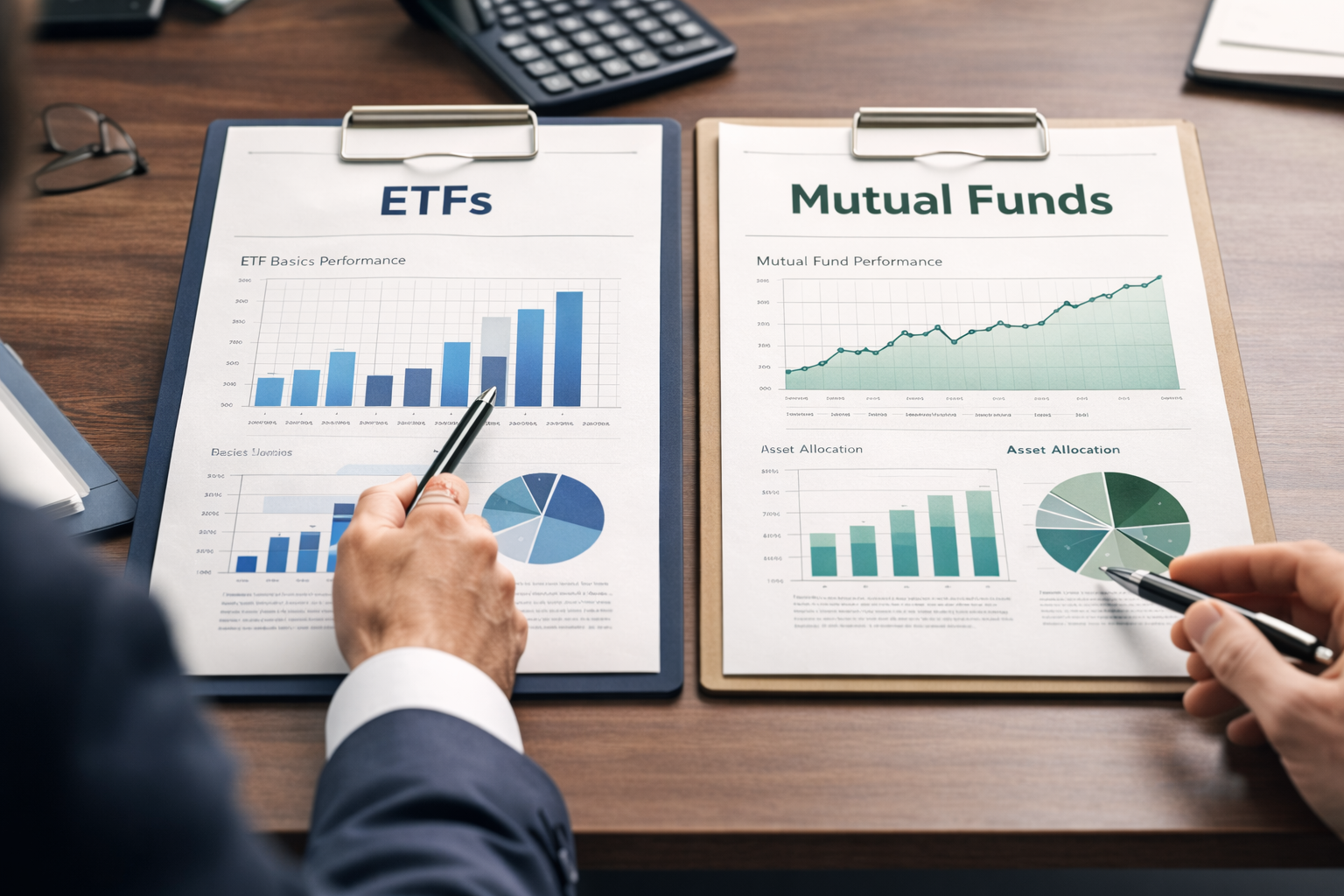
When I first heard “ETF” and “mutual fund,” I assumed they were basically the same thing with different names. Both are baskets of investments, both can track an index, both can be low-cost, and both can help you diversify without picking individual stocks.
But once I actually started investing, the differences started to matter in very real ways: how I placed orders, when I got my price, what fees I paid, and how taxes showed up in my account.
So here’s the real, practical comparison, explained like a normal person who just wants to invest without turning it into a second job.
First: what they have in common
ETFs and mutual funds both let you pool your money with other investors so the fund can buy a portfolio of assets (stocks, bonds, or other securities). The SEC describes ETFs as pooled investment vehicles, similar in concept to mutual funds, but traded on exchanges. Source: https://www.sec.gov/investor/alerts/etfs.pdf� �
Comisión de Valores Mobiliarios
So the “basket” idea is the same. The big differences are in how they’re bought/sold, how they’re priced, and some practical cost/tax quirks.
The quickest definition (so we don’t pretend this is complicated)
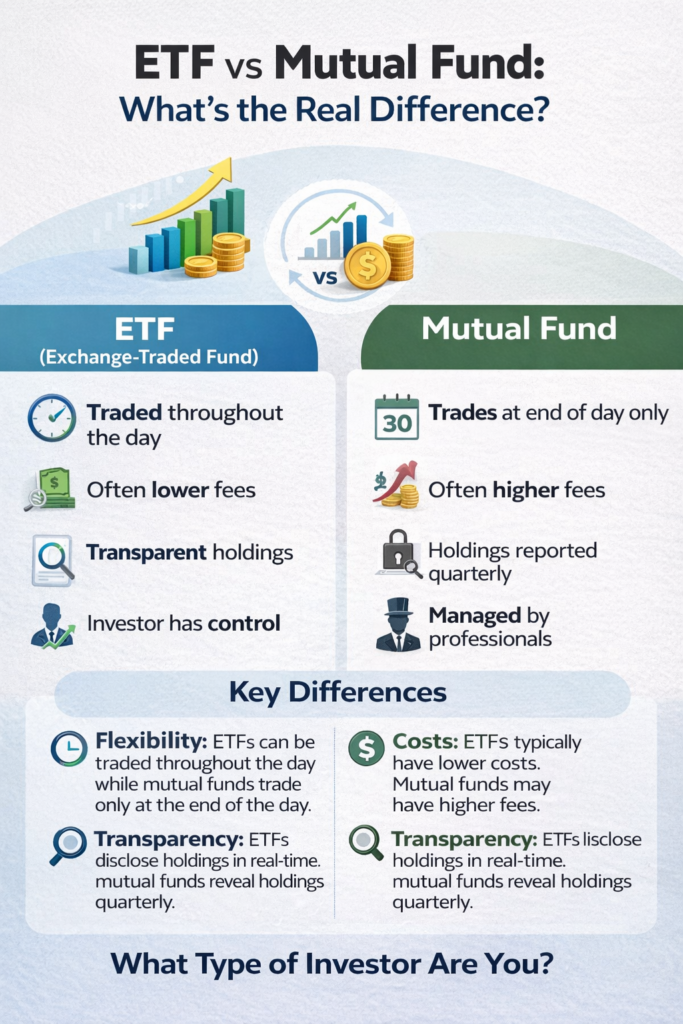
ETF (Exchange-Traded Fund): trades like a stock during the day on an exchange. Price moves intraday. Source: https://www.finra.org/investors/insights/etf-vs-mutual-fund� �
Mutual fund: typically priced once per day after the market closes, and everyone gets the same end-of-day NAV price. Source: https://www.finra.org/investors/insights/etf-vs-mutual-fund� �
That one difference alone changes a lot of things.
1) Pricing and trading: intraday vs end-of-day
This is the difference you feel immediately.
ETFs
If I buy an ETF at 10:17 a.m., I get whatever the market price is at 10:17 a.m. If it jumps at 10:18 a.m., I missed it. If it dips, I might get a better entry. You can use limit orders, stop orders, and all the “stock-style” order types. Vanguard explains the practical side of this pretty clearly. Source: https://investor.vanguard.com/investor-resources-education/etfs/etf-vs-mutual-fund� �
Mutual funds
With most mutual funds, I place an order during the day, but I don’t get a final price until after the market closes (typically 4 p.m. Eastern). Everyone who buys or sells that day gets the same NAV price. Schwab describes this execution difference simply: mutual fund orders execute once daily, ETFs trade all day. Source: https://www.schwab.com/etfs/mutual-funds-vs-etfs� �
Schwab Brokerage
Real-world implication:
If you like control and flexibility, ETFs feel easier. If you want simplicity and don’t care about intraday pricing, mutual funds are fine.
2) Costs: expense ratios are only part of the story
People obsess over expense ratios (the annual management fee), and yes, they matter. But there are a couple extra cost details that show up differently.
Expense ratios (a real example)
Vanguard’s S&P 500 ETF (VOO) has an expense ratio of 0.03%. Source: https://investor.vanguard.com/investment-products/etfs/profile/voo� �
That’s about $3 per year for each $10,000 invested. It’s hard to complain about that with a straight face.
ETF “hidden-ish” costs: bid-ask spread
ETFs trade like stocks, so there’s usually a bid price and an ask price. The gap between them (the spread) is a cost you pay indirectly when you buy and sell. For very liquid ETFs (like big S&P 500 ETFs), spreads are often tiny. For niche ETFs, spreads can be larger.
Mutual funds don’t have bid-ask spreads in the same way. You buy/sell at NAV.
My personal rule: if I’m buying broad, liquid ETFs and holding long term, spreads are basically background noise. If I’m messing with niche ETFs, I pay more attention.
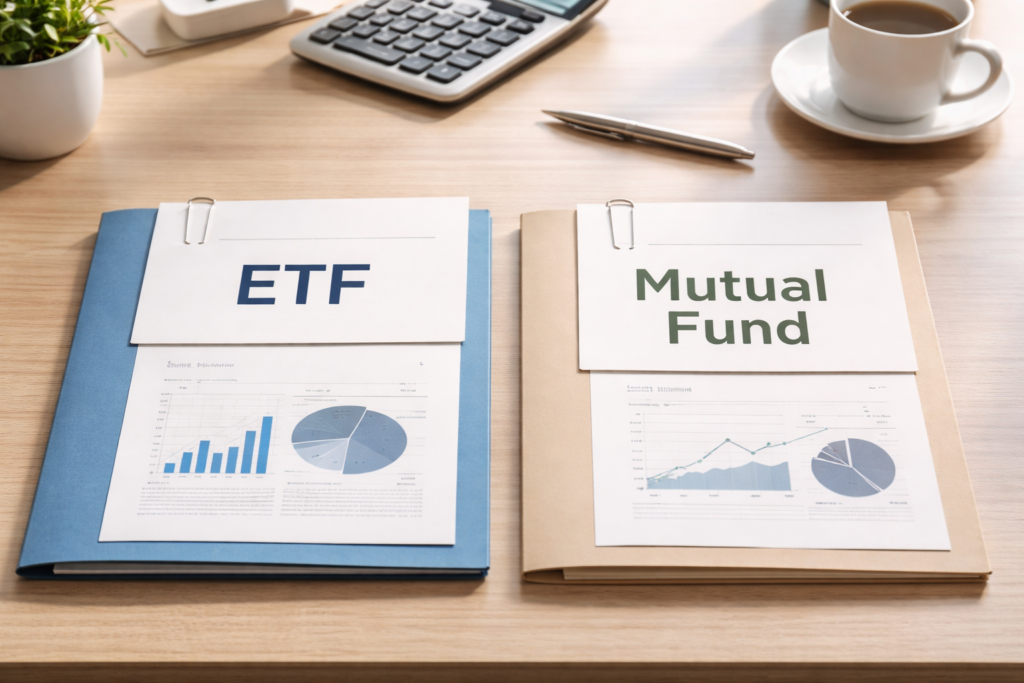
Mutual fund “hidden-ish” costs: loads and share classes
Some mutual funds have sales loads (front-end or back-end fees) or higher-cost share classes. Not all do, but it’s common enough that beginners should check before buying.
ETFs usually don’t have loads. You just pay the ETF’s expense ratio and whatever trading friction your broker has (often $0 commission now, depending on broker).
3) Taxes: where ETFs often have an edge
This is one of those topics people avoid because it sounds boring, but it can matter.
In many cases, ETFs can be more tax-efficient than mutual funds, especially in taxable brokerage accounts, because of the ETF creation/redemption mechanism. The SEC bulletin covers that ETFs have structural differences from mutual funds and how they trade and price. Source: https://www.sec.gov/investor/alerts/etfs.pdf� �
Comisión de Valores Mobiliarios
Meanwhile, mutual funds can distribute capital gains to shareholders when the fund sells holdings inside the fund, which can create a tax bill even if you personally didn’t sell anything. (This depends heavily on the type of mutual fund, turnover, and structure, but it’s a real consideration.)
Simple takeaway:
In a retirement account (401(k), IRA), tax efficiency differences matter less.
In a taxable account, ETFs often have an advantage, especially broad index ETFs.
4) Minimums and automation: mutual funds can still be easier
This is where mutual funds can win for a lot of normal humans.
Mutual funds and automatic investing
Many mutual funds let you set up automatic investing in dollar amounts very easily: “invest $200 every payday,” done.
ETFs increasingly support fractional shares and automated purchases depending on the broker, but the experience varies by platform.
Minimum investments
Some mutual funds have minimums (like $1,000 or $3,000), depending on the fund company and share class. ETFs don’t have fund minimums, but you may be limited by share price unless your broker supports fractional shares.
If you’re starting with small amounts and want ‘set it and forget it’: mutual funds can still be the smoothest path, depending on where you invest.
5) Transparency: ETFs typically disclose holdings more frequently
Many ETFs disclose holdings daily (especially index ETFs). Mutual funds often disclose holdings quarterly with a lag. This isn’t always a huge deal for index investing, but if you care about what you own today (not what you owned last quarter), ETFs often feel more transparent.
| Feature | ETF | Mutual Fund |
|---|---|---|
| Trading | All day | End of day |
| Fees | Lower | Higher |
| Management | Passive | Active |
| Transparency | Daily | Quarterly |
| Flexibility | High | Limited |
6) How big is the ETF market now?
This isn’t some niche product anymore. The Investment Company Institute’s Fact Book reports that at year-end 2023, the U.S. ETF market had 3,108 funds with $8.1 trillion in total net assets. Source: https://icifactbook.org/pdf/2024-factbook-ch4.pdf� �
Icifactbook
For context, the same ICI quick facts show mutual funds at about $25.5 trillion in net assets at year-end 2023, versus $8.085 trillion for ETFs. Source: https://www.ici.org/files/2024/2024-factbook-quick-facts-guide.pdf� �
So mutual funds are still bigger, but ETFs are massive and mainstream.
7) A numbers example that actually matters
Let’s say you invest $10,000 and hold it for years.
With a 0.03% expense ratio, you pay about $3 per year. (Example: VOO) �
With a 0.75% expense ratio, you pay about $75 per year on $10,000.
That difference sounds small until you scale it:
On $100,000: $30/year vs $750/year.
Over decades: it compounds into a huge gap.
Fees are the kind of boring detail that quietly decides how much money you keep.
Entonces, ¿cuál deberías elegir?
The honest answer
For most beginners, either can work. The biggest mistake isn’t “ETF vs mutual fund.” It’s paying high fees, holding a messy random portfolio, and panic-selling.
If you’re keeping costs low, staying diversified, and investing consistently, you’re already ahead of the majority of people.
Nuestra misión es simple: hacer que la inversión en ETF sea clara, práctica y a largo plazo. Descubra nuestra historia completa en la página Acerca de.
Leave a Reply