
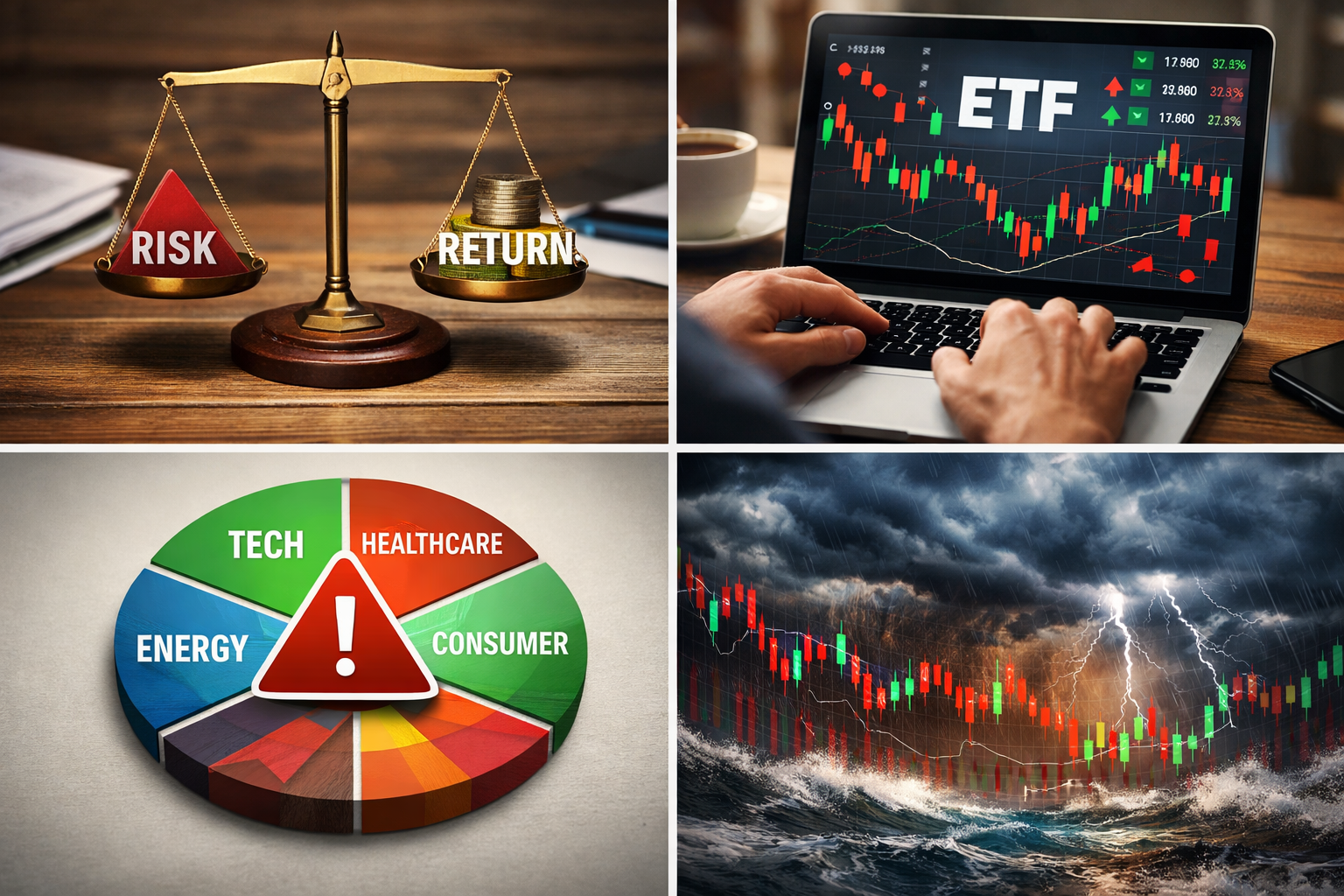
I like ETFs for one simple reason: they usually do exactly what they promise. They give me diversified exposure, low costs, and flexibility. I can buy them like stocks, hold them long term, or use them tactically. They’re transparent. They’re regulated. They’re efficient.
But when someone asks me, “Are ETFs safe?”, I don’t answer with a lazy yes.
The honest answer is more nuanced. Most mainstream ETFs are structurally robust and heavily regulated, but that does not mean your money is protected from loss. The ETF wrapper is generally safe. The market risk inside it is not.
Understanding that distinction changes everything.
Structural Safety vs Investment Risk
When I evaluate ETF safety, I separate two completely different ideas.
First, structural safety. This means the legal and operational framework behind the ETF. Are assets segregated? Is it regulated? Is there custody oversight? Could the product collapse due to structural failure?
Second, investment risk. This is about price volatility, drawdowns, and long periods of underperformance. No regulatory framework eliminates that.
Most fear around ETFs confuses these two things.
From a structural standpoint, most U.S. ETFs are registered under the Investment Company Act of 1940. That framework requires asset segregation, independent boards, disclosure standards, and strict custody rules. This is the same regulatory backbone that governs mutual funds. The SEC’s investor bulletin on ETFs explains this clearly:
https://www.sec.gov/investor/alerts/etfs.pdf
This is not experimental financial engineering anymore. According to the Investment Company Institute, U.S. ETFs held approximately $13.37 trillion in assets as of December 2025. That level of scale signals infrastructure maturity.
ICI data: https://www.ici.org/research/stats/etf/etfs_12_25
The plumbing is not fragile.
But none of that protects you from market losses.
| Metric | What It Tells You | “Healthy” Range (Broad ETF) | Red Flag Level |
|---|---|---|---|
| Max Drawdown (10y) | Worst peak-to-bottom fall | -30% to -40% | Below -50% |
| % of Top 5 Holdings | Concentration risk | < 25% | > 40% |
| Tracking Difference (annual) | Real gap vs index after costs | < 0.30% | > 1% |
| Bid-Ask Spread (normal market) | Hidden trading cost | < 0.10% | > 0.50% |
| % Days with >2% Move (year) | Volatility frequency | < 15% | > 25% |
| AUM Stability (1y change) | Investor confidence / liquidity risk | Stable or growing | -20% or worse |
Market Risk Is the Real Risk
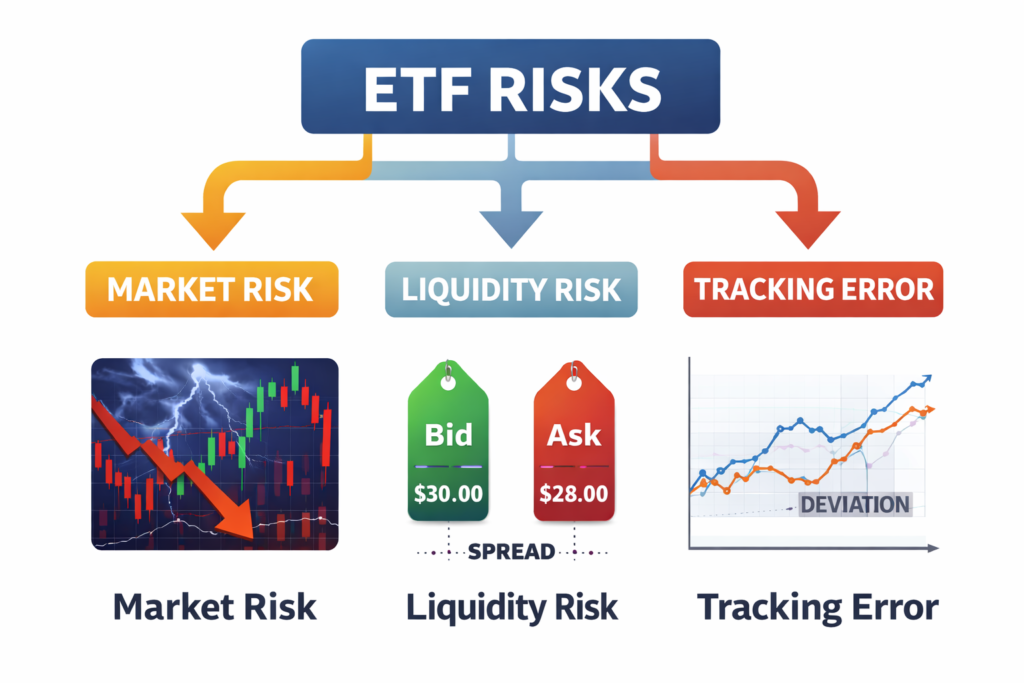
If I buy an S&P 500 ETF, I’m buying the U.S. stock market. And the U.S. stock market falls. Historically, it has experienced multiple drawdowns exceeding 20 percent. In 2008, the S&P 500 fell about 37 percent for the year. In early 2020, it dropped roughly 34 percent peak to trough in a matter of weeks. In 2022, it declined around 18 percent.
An ETF did not fail during those periods. The market moved.
That distinction matters. An ETF tracking equities will behave like equities. If it holds long-term bonds, it will react to interest rate changes. If it holds emerging markets, currency and political risks apply.
The structure is stable. The asset class is volatile.
Calling an ETF “safe” without specifying what it holds is meaningless.
Broker Failure and SIPC: What Is Actually Protected
Another fear I often hear is about broker collapse. What if my brokerage fails?
In the U.S., if your broker is a member of SIPC, protection covers up to $500,000 per customer, including up to $250,000 for cash, if securities are missing due to broker failure.
Official explanation: https://www.sipc.org/for-investors/what-sipc-protects
But here’s the part that many investors misunderstand. SIPC does not protect against investment losses. If your ETF declines 30 percent because the market fell, that is not covered. SIPC protects custody, not performance.
So from a structural standpoint, custody risk at large U.S. brokerages is relatively low. Market risk remains entirely yours.
Liquidity and Trading Risk
Large, broad-market ETFs are among the most liquid securities in the world. However, not all ETFs trade equally. Smaller niche funds can have wider bid-ask spreads and lower daily volume. In volatile markets, ETFs can trade at slight premiums or discounts to their net asset value.
FINRA provides a good overview of ETF trading mechanics and risks:
https://www.finra.org/investors/investing/investment-products/exchange-traded-funds-and-products
In practice, liquidity risk is usually about execution cost rather than catastrophic failure. Using limit orders instead of market orders helps control this.
Again, this is not structural collapse risk. It’s trading friction risk.
Tracking Error and Costs
One area investors underestimate is tracking error. An ETF aims to replicate an index, but it may deviate due to fees, trading costs, sampling methods, and rebalancing timing.
Costs play a major role here. According to ICI research, the asset-weighted average expense ratio for index equity ETFs has been around 0.14 percent, while the simple average across all funds is higher, around 0.45 percent in recent reports.
ICI fee report: https://www.ici.org/files/2025/per31-01.pdf
That gap tells an important story. Most investor money flows to low-cost ETFs. Over decades, a 0.30 percent fee difference compounds meaningfully.
Low cost does not guarantee high returns, but high cost reliably reduces them.
Derivatives, Leverage, and Complexity
This is where ETF safety becomes conditional.
Some ETFs use futures, swaps, or options to achieve their objectives. Leveraged ETFs reset daily. Inverse ETFs attempt to move opposite an index’s daily return. Because of daily compounding, long-term returns can diverge significantly from what many investors expect.
A 3x leveraged ETF does not simply deliver three times the long-term performance of an index. Volatility drag alters outcomes.
These products are not structurally unsafe. But they are behaviorally dangerous if misunderstood.
The risk is complexity, not collapse.
So Are ETFs Safe?
If I am talking about broad, low-cost index ETFs issued by large sponsors, regulated under the 1940 Act, held at reputable brokerages, and used for long-term investing, I consider them structurally among the safest investment vehicles available to retail investors.
But safe does not mean stable. It does not mean immune from 30 percent drawdowns. It does not mean guaranteed returns. It does not mean protection from poor timing decisions.
It means the structure is sound. The risk is market-based.
And that’s an important difference.
This site was built to simplify ETF investing and remove the noise. You can read more about our approach and principles on the About page.
Leave a Reply