
The first time I bought an ETF, I remember staring at my screen thinking:
“Okay… I own it now. But how exactly does this thing make me money?”
It sounds like a beginner question, but it’s actually the right question. If you don’t understand how something generates returns, you’re basically just hoping.
So let’s simplify it.
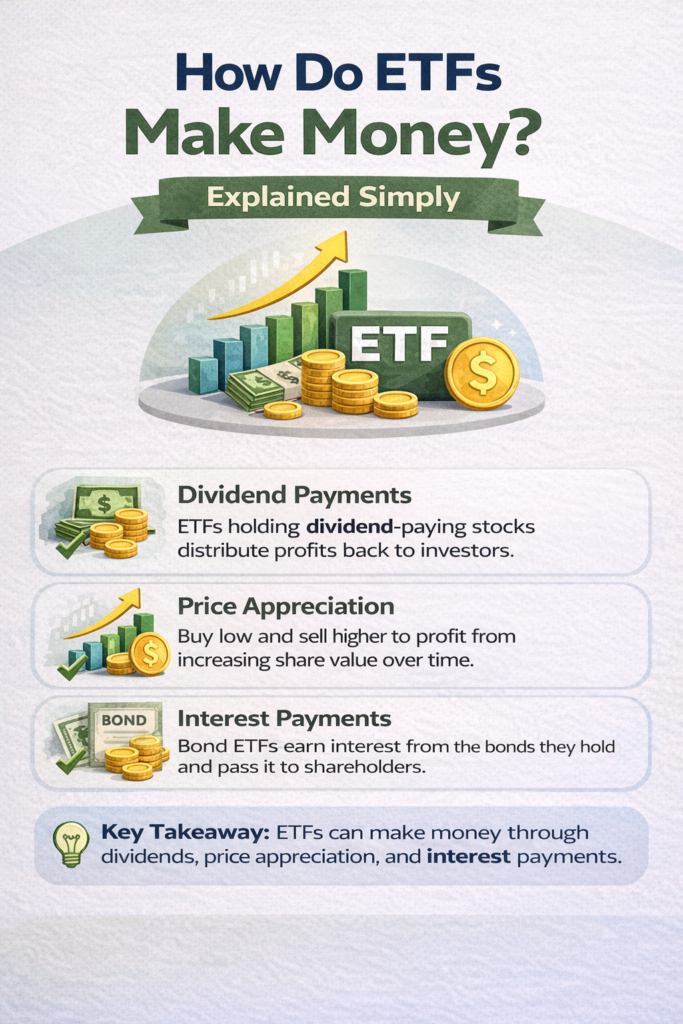
ETFs make money because the assets they own make money.
There’s no hidden engine. No secret yield machine. An ETF is just a wrapper around real investments — stocks, bonds, or other assets.
If those assets grow, you grow.
Where the Returns Actually Come From
Most stock ETFs track indexes like the S&P 500 or the total U.S. stock market.
For example:
- VOO tracks the S&P 500
https://investor.vanguard.com/investment-products/etfs/profile/voo - VTI tracks the total U.S. stock market
https://investor.vanguard.com/investment-products/etfs/profile/vti
If the companies inside those indexes increase in value, the ETF price rises.
That’s the primary engine.
According to long-term historical data compiled by NYU Stern, the S&P 500 has returned roughly 9–10% annually on average (nominal) over many decades.
Source: https://pages.stern.nyu.edu/~adamodar/New_Home_Page/datafile/histretSP.html
That return includes both price appreciation and dividends.
So when someone says, “the market grows over time,” what they’re really saying is that businesses tend to grow profits over time — and stock prices follow.
An ETF simply mirrors that growth.
| Source of Return | How It Works | Real Example | What It Means for You |
|---|---|---|---|
| Price Growth | The stocks or bonds inside the ETF increase in value | If the S&P 500 rises 8%, an S&P 500 ETF typically rises close to that | Your ETF share price increases |
| Dividends | Companies inside the ETF pay profits to shareholders | $50,000 in an ETF with 1.5% yield ≈ $750 per year | You receive income (or reinvest it) |
| Interest (Bond ETFs) | Bonds inside the ETF pay interest | A bond ETF yielding 3% pays $3,000 per year on $100,000 | Steady income stream |
| Compounding | Reinvested returns generate more returns | $10,000 at 7% for 30 years ≈ $76,000+ | Growth accelerates over time |
| Time in Market | Longer holding periods smooth volatility | 20–30 year investors historically capture market averages | Patience increases probability of gains |
Dividends: The Underrated Part
Price growth gets all the attention, but dividends quietly do a lot of heavy lifting.
Many ETFs hold dividend-paying companies. When those companies distribute profits, the ETF collects those payments and passes them on to shareholders.
The SEC explains that ETFs may distribute dividends or interest earned from the underlying holdings.
Source: https://www.sec.gov/investor/pubs/etfs.htm
Let’s make it concrete.
If you own $50,000 in an ETF with a 1.5% dividend yield, that’s roughly $750 per year in dividends.
You can take it in cash.
Or reinvest it.
Reinvested dividends are where long-term wealth really accelerates.
Compounding: The Real Multiplier
This is the part that changes everything.A=P(1+r)t
That formula explains why ETFs can build serious wealth over time.
You’re not just earning returns on your original investment.
You’re earning returns on previous returns.
For example, if you invest $10,000 at 7% annually for 30 years, you don’t earn 7% × 30. You earn growth on top of growth, year after year.
That’s compounding.
And ETFs make compounding easy because they’re diversified, low-cost, and simple to hold long term.
A Realistic Example
Let’s say you invest $300 per month in a broad U.S. market ETF.
That’s $3,600 per year.
Assume a 7% average annual return.
After 10 years, you’re around $50,000.
After 20 years, about $157,000.
After 30 years, roughly $365,000.
Those aren’t guarantees. Markets fluctuate. But they show how steady investing plus compounding creates results.
No stock picking required.
How ETF Companies Make Money
You make money from the performance of the underlying assets.
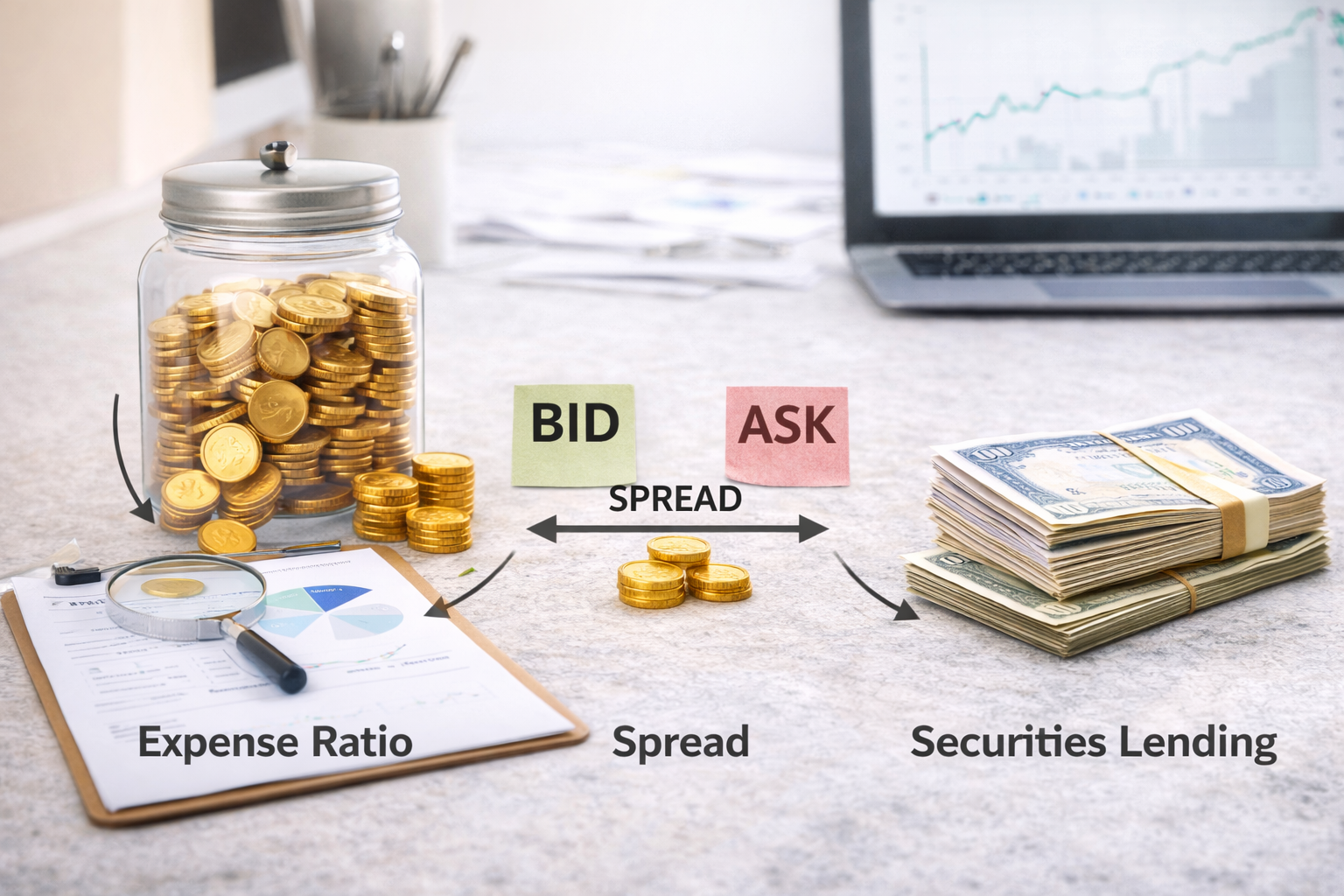
ETF providers make money through something called the expense ratio.
For example, VOO charges 0.03% annually.
Source: https://investor.vanguard.com/investment-products/etfs/profile/voo
That means about $3 per year for every $10,000 invested.
That fee goes to the fund company for managing and maintaining the ETF.
The key thing is that the fee is usually very small compared to the potential long-term growth.
What Happens When Markets Fall?
ETFs don’t protect you from market declines.
If the stock market drops 20%, your stock ETF likely drops close to that.
They reduce company-specific risk (because you’re diversified), but they don’t eliminate market risk.
That’s important to understand.
You make money when markets rise over time. You lose value during downturns.
The long-term return depends on staying invested.
Bond ETFs Work a Bit Differently
Bond ETFs don’t rely on corporate growth.
They earn money through:
- Interest payments
- Price changes tied to interest rates
If rates fall, bond prices often rise.
If rates rise sharply, bond ETFs can decline.
Different mechanics, same idea: the ETF earns based on what it owns.
Taxes Also Affect What You Keep
In taxable brokerage accounts, you may owe:
- Capital gains tax when you sell at a profit
- Taxes on dividends received
ETFs are often considered relatively tax-efficient because of their structure, as outlined by the SEC.
Source: https://www.sec.gov/investor/alerts/etfs.pdf
But the exact impact depends on your account type and personal tax situation.
So How Do You Actually Make Money?
In plain terms:
You buy an ETF.
The companies inside grow profits.
Stock prices increase.
Dividends are paid.
You reinvest.
Time passes.
Compounding does the work.
There’s no trick.
ETFs don’t manufacture returns.
They simply give you ownership in productive assets.
If those assets grow, you grow.
And historically, diversified U.S. equities have grown over long periods — though not smoothly.
Final Thought
ETFs are not exciting.
They’re not flashy.
They don’t promise overnight wealth.
But they work because businesses grow, profits accumulate, and low costs let you keep most of the returns.
If you understand that ETFs make money by owning assets that produce value over time, you already understand the foundation of long-term investing.
And honestly, that’s enough.
Curious about who’s behind ETF Anchor and why we focus on long-term ETF investing? Visit our About page
to learn more.
Leave a Reply