
I remember the first time I compared VTI and VOO. I expected one of them to clearly win. Something obvious. Something that would make the decision easy.
That didn’t happen.
Instead, I found two ETFs that are almost frustratingly similar. Same provider, same low fees, same long-term philosophy. And yet, they represent two slightly different ways of thinking about the market.
So instead of asking “which one is better,” I started asking a different question:
What exactly am I buying with each one?
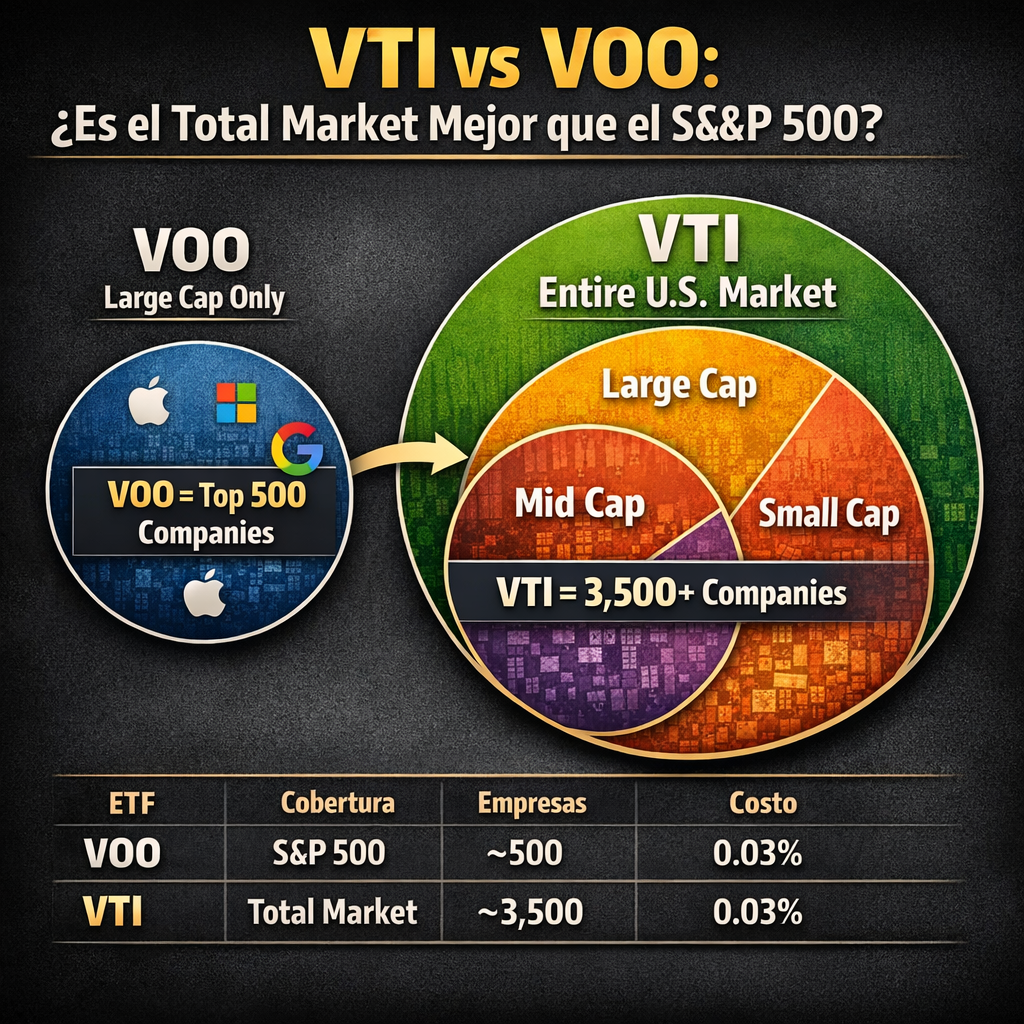
What you’re actually investing in
VOO is simple. It tracks the S&P 500. That means you’re buying into the 500 largest companies in the U.S.
Names you already know:
Apple, Microsoft, Amazon, Nvidia…
VTI goes further. It includes the entire U.S. stock market. Not just the big names, but also mid-sized companies and thousands of smaller ones.
On paper, that sounds like a big difference.
In practice, it’s not as dramatic as it seems.
Large companies still dominate VTI. Most of your money ends up in the same names you’d get with VOO anyway. The smaller companies are there, but they don’t carry much weight.
Costs (basically irrelevant here)
Both VTI and VOO charge 0.03%.
That’s about $3 a year for every $10,000 invested.
At this level, fees are not the reason you choose one over the other. If you’re debating this part, you’re focusing on the wrong thing.
Performance: the part people care about
If you look at the last decade, VOO has slightly outperformed VTI.
Not by a huge margin, but enough to notice.
The reason is pretty simple. Large-cap stocks, especially tech, have dominated the market for years. And VOO is more concentrated in those companies.
VTI includes small caps, and recently they haven’t pulled their weight.
So VOO ends up looking a bit stronger.
But here’s the uncomfortable truth:
That could change.
Small caps have had periods where they outperform. When that happens, VTI benefits more than VOO.
The problem is… nobody knows when that shift comes.
| Característica | VTI (Total Market) | VOO (S&P 500) |
|---|---|---|
| Índice | CRSP US Total Market | S&P 500 |
| Nº de empresas | ~3.700 | ~500 |
| Tipo de empresas | Grandes + medianas + pequeñas | Solo grandes (megacaps) |
| Peso de grandes empresas | Muy alto (~80%) | Extremadamente alto (~100%) |
| Diversificación | Muy alta | Alta |
| Rentabilidad histórica | Muy similar a VOO | Muy similar a VTI |
| Volatilidad | Ligeramente mayor | Ligeramente menor |
| TER (coste) | 0.03% | 0.03% |
| Dividendos | ~1.3% | ~1.4% |
| Enfoque | Mercado completo | Top empresas USA |
Diversification: theory vs reality
This is where VTI is supposed to shine.
More companies = more diversification.
And that’s true, technically.
But in reality, both ETFs behave very similarly because large caps still dominate the market. You’re not getting a completely different experience. You’re just adding a layer on top.
Still, that layer might matter over very long periods.
Risk and behavior
VOO tends to feel a bit more stable. Big companies, steady earnings, less drama.
VTI adds more movement because of small caps.
Not extreme volatility, but enough that you might notice it during rough periods.
For long-term investors, both are perfectly fine. The bigger risk isn’t the ETF. It’s how you react when the market drops.
So… which one would I pick?
This is where it gets annoyingly subjective.
If I want something simple, clean, and focused on what’s already working, I lean toward VOO.
If I want to cover the entire market and not think too much about what segment will outperform in the future, I lean toward VTI.
But here’s the part that took me too long to accept:
The difference is small.
Much smaller than most articles make it sound.
The mistake most people make
People spend hours comparing VTI vs VOO…
…and then invest nothing.
Or worse, they keep switching between them trying to “optimize.”
That’s where returns actually get destroyed.
Not in the choice between these two.
Final thoughts
If you pick VOO, you’re betting on the biggest companies in the U.S. continuing to lead.
If you pick VTI, you’re betting on the entire market, including whatever comes next.
Both are solid.
Both have worked.
Both will probably keep working.
The real edge isn’t in choosing perfectly. It’s in staying consistent when things get boring… or uncomfortable.
Curious about who’s behind ETF Anchor and why we focus on long-term ETF investing? Visit our About page
to learn more.
Leave a Reply