
When I first started investing, I thought I had to pick individual stocks to make real money. I remember spending hours reading about companies, earnings reports, and analyst opinions. It felt complicated — and honestly, stressful.
Then I discovered ETFs.
And everything got simpler.
If you’re new to investing, an ETF might be the most important concept you learn.
Let’s break it down in plain English.
So… what exactly is an ETF?
ETF stands for Exchange-Traded Fund.
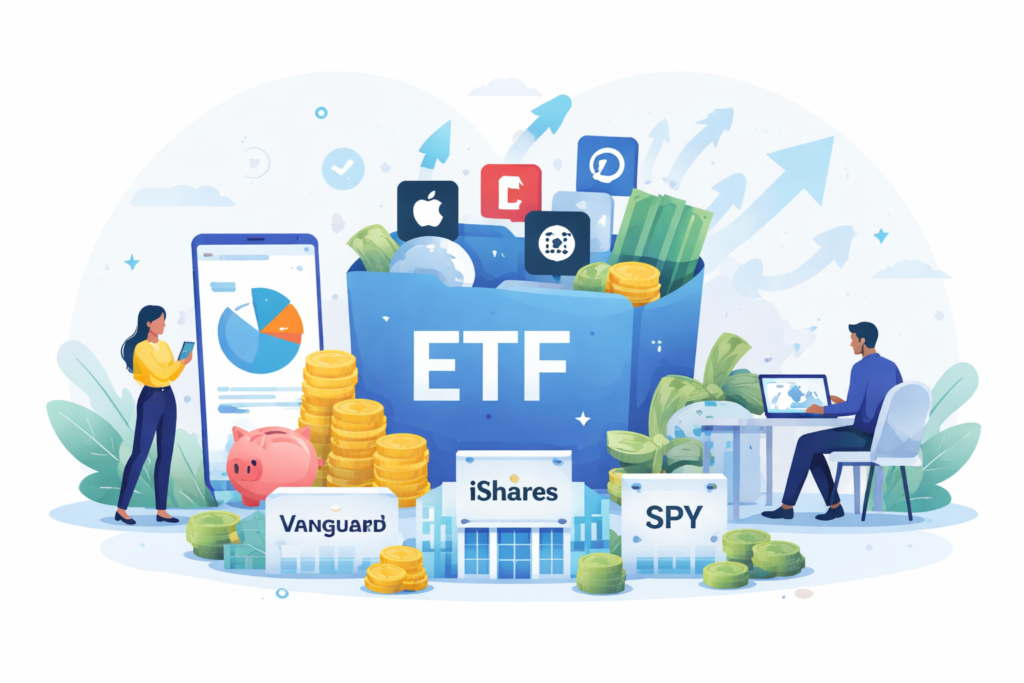
That sounds technical, but the idea is simple: an ETF is a fund that owns a collection of investments — stocks, bonds, or other assets — and trades on a stock exchange just like a regular stock.
The U.S. Securities and Exchange Commission describes ETFs as pooled investment vehicles that trade throughout the day on exchanges, similar to individual stocks.
(Source: https://www.sec.gov/investor/pubs/etfs)
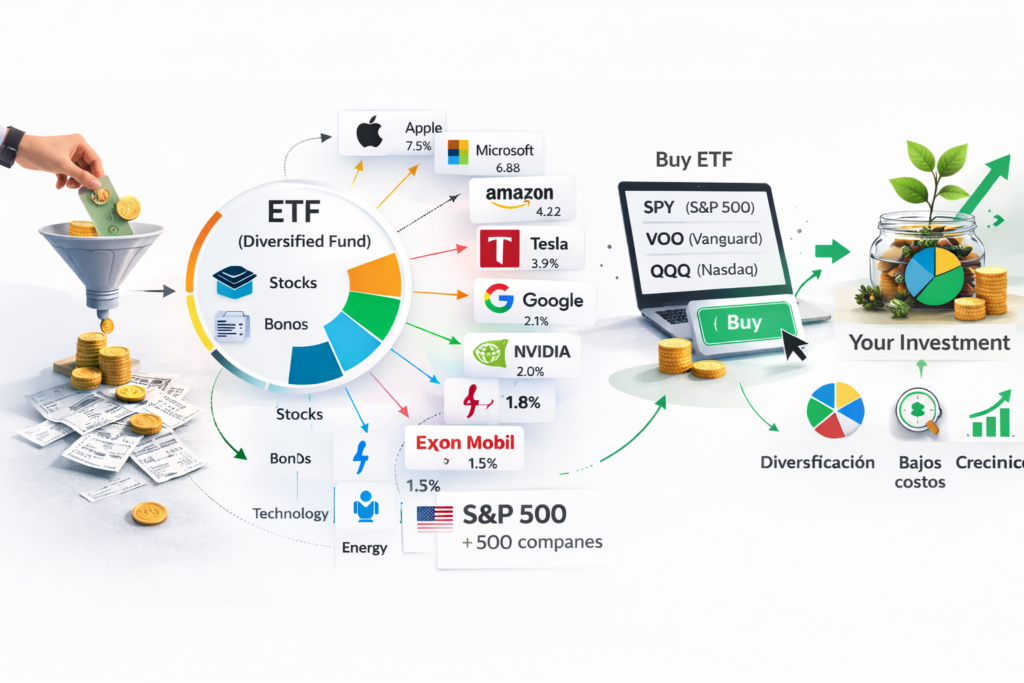
In practical terms, buying one ETF share means you instantly own small pieces of many companies.
Instead of buying Apple, Microsoft, Amazon, Google, and hundreds of others one by one, you can buy one ETF that already holds them.
That’s powerful.
ETF Growth Calculator
This is a simplified educational estimate. Real ETF returns fluctuate and are not guaranteed.
How does an ETF actually work?
Most ETFs track an index.
For example:
- SPY tracks the S&P 500.
- VTI tracks the entire U.S. stock market.
- BND tracks U.S. investment-grade bonds.
If the companies inside the index go up, the ETF goes up. If they fall, the ETF falls.
That’s it.
Behind the scenes, large financial institutions create and redeem ETF shares to keep the price aligned with the value of the underlying assets. This mechanism helps ETFs trade very close to their net asset value (NAV). The SEC explains this structure in more detail in its ETF investor bulletin.
(Source: https://www.sec.gov/investor/pubs/etfs)
As an individual investor, you don’t need to worry about the mechanics. You just buy and sell it like a stock.
Why ETFs became so popular in the U.S.
ETFs aren’t a niche product anymore.
According to the Investment Company Institute (ICI), U.S.-listed ETFs held approximately $8 trillion in assets in recent years.
(Source: https://www.ici.org/statistical-report/etf)
That’s institutional-level money.
The reason is simple: ETFs combine diversification, low costs, and flexibility in one product.
And for long-term investors, that combination is hard to beat.
Costs: The quiet difference maker
One thing I didn’t understand when I started investing was how much fees matter.
Many ETFs are extremely low-cost.
For example:
- Vanguard S&P 500 ETF (VOO) has an expense ratio of 0.03%.
(Source: https://investor.vanguard.com/investment-products/etfs/profile/voo)
That means if you invest $10,000, you pay about $3 per year in management fees.
Compare that to actively managed funds that often charge 0.75% to 1% annually.
Let’s put numbers on that.
If you invest $100,000 for 30 years at a 7% annual return:
- With a 0.03% fee, you could end up around $761,000.
- With a 1% fee, you might end closer to $574,000.
That’s a difference of roughly $187,000 — just because of fees.
Fees don’t look dramatic in year one. They look dramatic in year thirty.
Diversification without the headache
One of the biggest advantages of ETFs is instant diversification.
Take VTI, Vanguard’s Total Stock Market ETF. It holds more than 3,500 U.S. companies.
(Source: https://investor.vanguard.com/investment-products/etfs/profile/vti)
That means when you buy one share, you’re spreading your risk across thousands of businesses.
If one company collapses, it barely affects your portfolio.
That doesn’t eliminate market risk. If the whole market drops, your ETF drops too. But it dramatically reduces single-company risk.
For beginners, that’s a big deal.
Liquidity and flexibility
Unlike traditional mutual funds, ETFs trade throughout the day.
You can buy them at 10:15 a.m., sell at 2:40 p.m., or hold them for 30 years.
Their price fluctuates based on supply and demand during market hours, just like a stock.
That flexibility makes ETFs attractive not only for long-term investors but also for traders.
Real-world example: investing consistently
Let’s say you invest $300 per month in a broad U.S. market ETF.
That’s $3,600 per year.
Assume a 7% average annual return.
After 10 years: about $50,000
After 20 years: about $157,000
After 30 years: about $365,000
Those aren’t guaranteed numbers. Markets fluctuate.
But historical long-term returns of the S&P 500 have averaged around 9–10% before inflation over many decades, according to data compiled by NYU Stern.
(Source: https://pages.stern.nyu.edu/~adamodar/New_Home_Page/datafile/histretSP.html)
The point isn’t predicting exact returns.
It’s understanding what consistent investing can do.
Different types of ETFs
Not all ETFs are broad market funds.
There are:
- Sector ETFs (Technology, Energy, Healthcare)
- Bond ETFs
- International ETFs
- Dividend ETFs
- Thematic ETFs (AI, clean energy, etc.)
- Commodity ETFs (like gold)
For beginners, broad index ETFs usually make more sense than highly concentrated thematic funds.
The more specific the ETF, the higher the potential volatility.
What are the risks?
ETFs are not risk-free.
They carry:
Riesgo de mercado
Riesgo sectorial (si está concentrado)
Riesgo cambiario (para ETF internacionales)
Riesgo de tipo de interés (para ETF de bonos)
If the stock market drops 20%, your S&P 500 ETF will likely drop too.
The advantage is not protection from declines.
The advantage is simplicity and diversification.
Are ETFs better than individual stocks?
Not necessarily.
But for most beginners, ETFs offer:
- Lower research burden
- Broad diversification
- Low cost
- Simplicity
When I think about building wealth steadily instead of chasing headlines, ETFs make sense.
They’re not flashy.
They don’t promise overnight riches.
But they’ve become one of the most efficient tools individual investors have.
If I had to start from scratch today, ETFs would still be the foundation of my portfolio.
-This site was built to simplify ETF investing and remove the noise. You can read more about our approach and principles on the About page.
Leave a Reply